
24.09.2026 | Samuel Tremp
Lizenz: Adobe Stock

Terraform and IBM Bob: How AI Makes Infrastructure Automation More Intelligent in Hybrid Cloud Environments
Infrastructure as Code (IaC) has fundamentally changed how modern IT infrastructure is provisioned. Instead of configuring servers, networks, and cloud 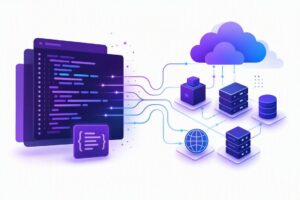 resources manually, teams describe their target environment in reusable, version-controlled configuration files.
Terraform is one of the established tools for declaratively provisioning infrastructure across different platforms. The benefits are clear: standardized processes, reproducible environments, better traceability, and tighter integration with DevOps and CI/CD pro-cesses.
However, as infrastructure grows, so do the demands. Terraform code becomes more extensive, modules become more complex, dependencies become harder to under-stand, and governance requirements become more comprehensive. This is precisely where combining Terraform with IBM Bob – the AI-powered development partner from IBM – can provide additional value.
IBM Bob can help teams translate infrastructure concepts into Terraform configurations more quickly, understand existing configurations more effectively, and analyze errors more systematically. In this way, AI does not replace platform and cloud experts; in-stead, it becomes a productive assistant within the infrastructure lifecycle.
Infrastructure as Code refers to the approach of defining IT infrastructure using code or declarative configuration files and provisioning it automatically.
Rather than creating network segments, security groups, or virtual machines individually through graphical user interfaces, for example, a team describes the desired state in Terraform. This description can then be reviewed, versioned, tested, and rolled out through automated processes.
Typical benefits of IaC include:
Reproducibility: Environments can be provisioned consistently. ……………………………………..
Version control: Changes can be tracked through version-control systems. …………………………………..
Automation: Provisioning and changes can be integrated into CI/CD processes. …………………………..
Standardization: Reusable modules promote consistent architectures. ………………………….
Transparency: Infrastructure changes can be reviewed and approved before exe-cution. ………………………
Scalability: The same approach can be used for individual workloads or large multi-cloud environments.
Terraform therefore provides an important foundation for modern platform and cloud engineering teams. However, IaC does not automatically make the operating environment simple. The larger the landscape, the more challenging modeling, dependencies, state management, testing, security policies, and documentation become.

IBM Bob complements the Terraform workflow with natural-language, dialog-based in-teraction. Instead of translating every requirement into Terraform syntax manually, teams can first describe their intent in everyday language and receive support with the implementation.
The specific quality of the results depends, among other things, on the model being used, the context provided, the organization’s policies, and the technical integration. Generated configurations should therefore always be reviewed, tested, and handled according to the established approval process.
1._Faster Development of Terraform Configurations
Creating Terraform code can be time-consuming-especially when multiple providers, modules, or dependencies are involved. IBM Bob can serve as a starting point for new configurations and help teams translate requirements into a technical structure more quickly.
For example, a natural-language request might be: “Create a Terraform structure for a highly available application with separated network segments, restrictive access rules, and environment separation for development and production.”
Such a draft does not replace architectural decisions. However, it can reduce the initial manual effort and serve as a basis for further refinement. This allows developers and platform teams to focus more on architecture, security, and operational requirements.
2. Easier Understanding of Complex Infrastructure
For example, the tool can:
In mature environments, it is often not immediately clear which resource depends on which other resource. In addition, modules may be distributed across multiple directories and connected through variables, outputs, and provider configurations.
IBM Bob can help make complex Terraform structures easier to understand. This is particularly valuable during handovers, audits, migrations, and the onboarding of new team members.
3. Support with Troubleshooting and Optimization
Terraform errors can have various causes: invalid parameters, unmet dependencies, permission issues, version conflicts, or differences between the configuration and the actual state of the infrastructure.
An AI-powered development partner can analyze error messages, highlight relevant sections of code, and suggest possible approaches to resolving the issue. Although the cause must still be technically verified, a structured analysis often shortens the time needed to find a solution.
It is important that teams do not ask only for an immediate fix, but also for the underlying cause and the risk associated with the proposed change. This helps prevent a problem from merely being bypassed and recurring later.
4. Greater Consistency and Better Governance
Possible review points include:
Terraform supports standardized provisioning. In practice, however, organizations must also ensure that configurations comply with security, compliance, and architecture requirements.
IBM Bob can help teams review configurations against defined criteria or suggest improvements.
AI assistance should be embedded within an existing governance model. Automated scans, policy as code, code reviews, and approvals remain important control mechanisms. IBM Bob can complement these processes, but it cannot replace organizational accountability.
5. Faster Onboarding and Higher Productivity
New team members can ask it to explain, for example:
Terraform requires knowledge of declarative configuration, cloud architecture, networking, identity and access management, and the relevant providers. New employees therefore often have to learn several technologies at the same time.
IBM Bob can serve as an interactive learning and explanation partner.
This promotes knowledge transfer and reduces dependence on individual experts. At the same time, organizations should ensure that answers are not adopted uncritically as authoritative documentation or architectural decisions.
The combination can be divided into several clearly defined steps.
Describe the Requirements: The team first defines the desired outcome: What application should be operated? What availability, security, and compliance requirements apply? In which environments should the infrastructure be deployed?
The more precise the requirements, the more useful AI assistance is likely to be.
Generate a Technical Draft: IBM Bob can derive an initial draft of Terraform files, variables, modules, or documentation from the requirements. This draft should be treated as a proposal – not as an implementation that is automatically ready for production.
Review Architecture and Security: Cloud and platform experts evaluate the proposal. Among other things, they review the network design, identity model, data flows, high availability, costs, and operational processes.
Perform Terraform Validation and Testing: The code is analyzed using the usual Terraform checks and the organization’s internal quality-assurance processes. Depending on the environment, these may include formatting, validation, plan reviews, static analysis, security scans, and automated tests.
Review and Approval: Changes are managed through version control, pull requests, and defined approval processes. This preserves traceability regarding who proposed, reviewed, and approved each change.
Controlled Provisioning: Only after successful review is the change rolled out through the designated deployment process. After deployment, monitoring, drift detection, and operational documentation should be updated.

A company operates applications in its own data center as well as with multiple cloud providers. The platform teams need to provision new environments more quickly while maintaining consistent security and governance requirements.
Terraform can provide standardized modules for networking, identity, compute, storage, and monitoring.
The real value does not come from automatically generating code alone. What matters is the combination of reusable Terraform components, clear policies, qualified reviews, and AI used in the right context.
Clear Internal Standards: IBM Bob delivers better results when organizations clearly document their preferred modules, naming conventions, provider versions, and security requirements.
High-Quality Context: Incomplete requirements often lead to incomplete results. Teams should provide relevant information, such as the target platform, region, dependencies, operating model, and compliance requirements.
Human Oversight: AI-generated infrastructure code may contain errors or unsafe assumptions. Every production change must therefore be validated and reviewed by responsible subject-matter experts.
Protection of Sensitive Information: Credentials, private keys, and other confidential information must not be entered into prompts or configurations in an uncontrolled manner. Organizations should establish clear requirements for data classification, access, logging, and the use of AI systems.
The combination of Terraform and IBM Bob is powerful, but it does not automatically eliminate all the responsibilities of a platform team.
The greatest impact is achieved when IBM Bob is integrated as an assistance layer within a controlled engineering process. AI can accelerate suggestions and make knowledge more accessible. Responsibility for design, risk, and operations remains with the organization and its experts.
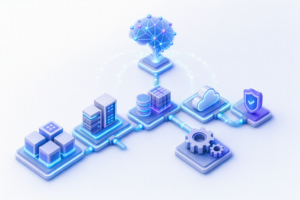 Terraform provides the foundation for reproducible and standardized infrastructure. IBM Bob can enhance this foundation with a dialog-based, AI-supported development experience.
Together, the technologies can help teams create Terraform configurations more quickly, understand complex environments more effectively, analyze errors efficiently, and apply standards more consistently.
However, the greatest benefit does not lie in simply generating code. It comes from intelligently combining human expertise, Infrastructure as Code, automation, governance, and AI-supported collaboration.
For organizations operating hybrid and multi-cloud environments, Terraform combined with IBM Bob can therefore be an important building block for scaling platform engineering, accelerating modernization, and sustainably reducing operational complexity.
In short: Terraform automates the infrastructure. IBM Bob can help teams design it faster, understand it better, and continue developing it more intelligently.
Discover how modern infrastructure automation and artificial intelligence can help make hybrid cloud environments more efficient, agile, and future-ready.
Ready to unlock the full potential of automation and AI for your infrastructure? Our experts are here to help you identify the right solutions for your organization and accelerate your transformation journey.
Contact us today for a personalized consultation and discover how intelligent infrastructure can drive greater efficiency, consistency, and innovation across your IT operations.

Samuel Tremp
Business Development Manager IBM Software
samuel.tremp@tdsynnex.com
All articles by the author